
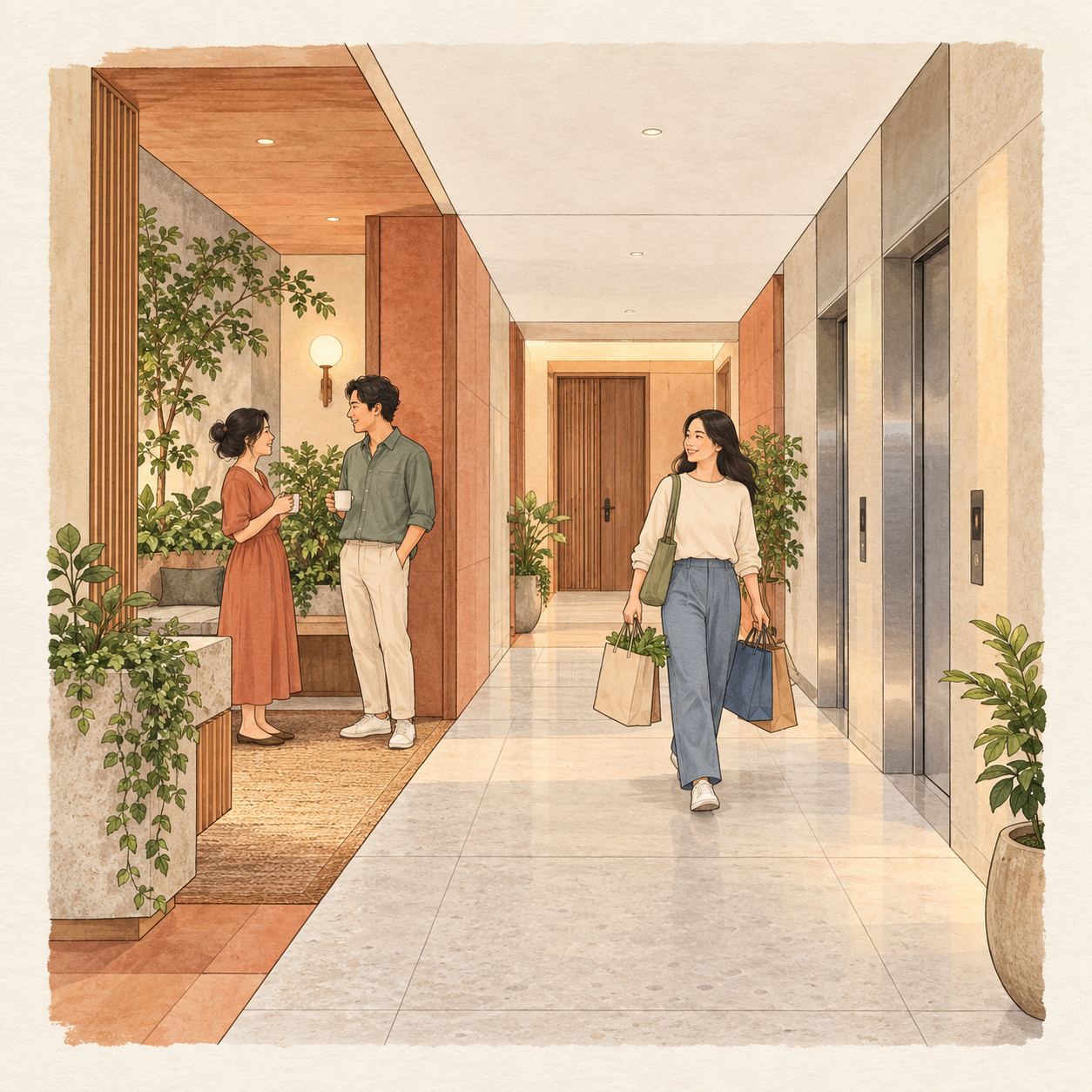
Imagine arriving home with shopping bags. Two neighbours are talking near the lift. You recognise one of them, exchange a few words and briefly join the conversation.
Elsewhere in the building, a room has been provided for residents to meet.
Why did the conversation happen here?
The common room asks you to go somewhere. The route home has already brought you together. A small exchange can begin without an invitation, an organised activity or a decision to spend the evening socialising.
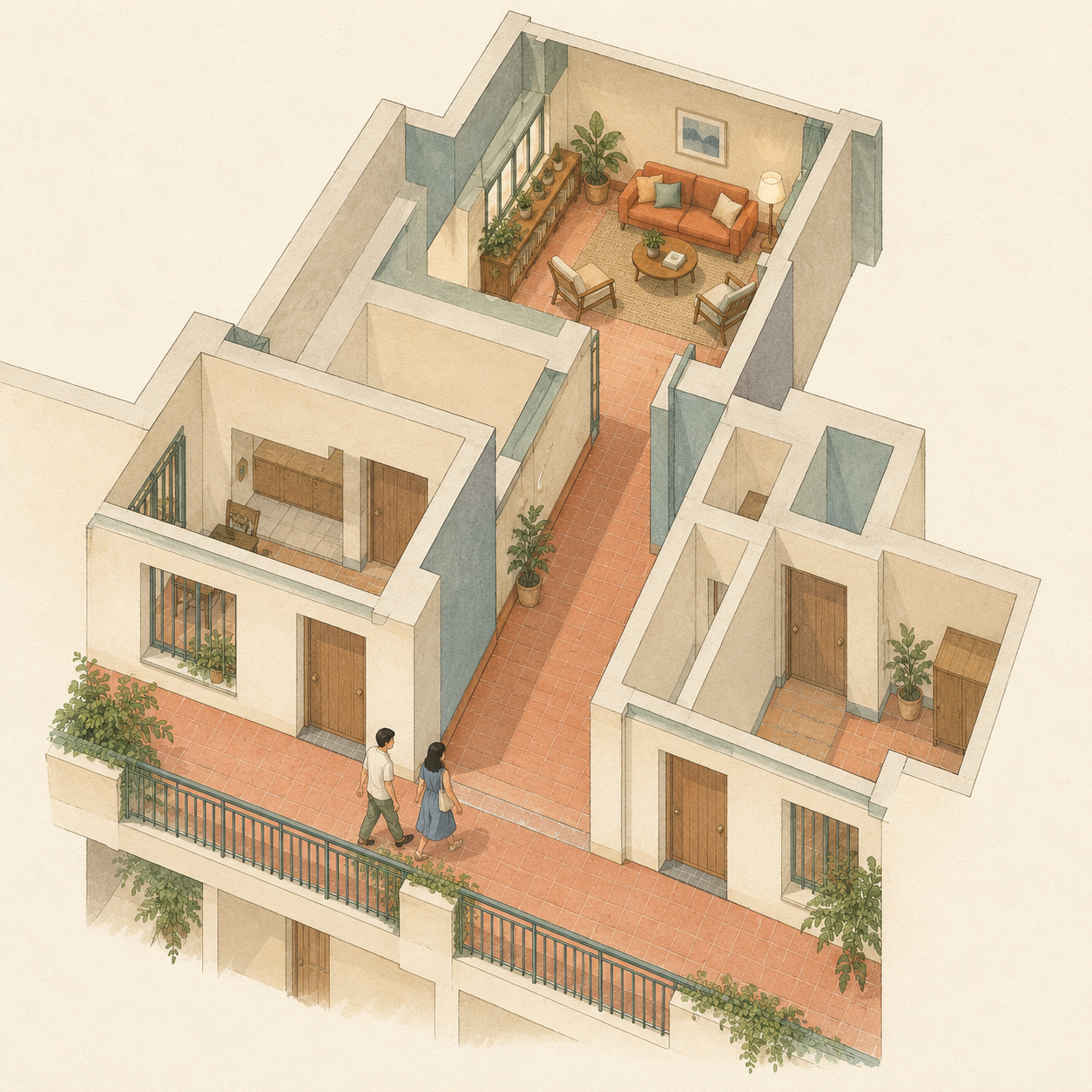
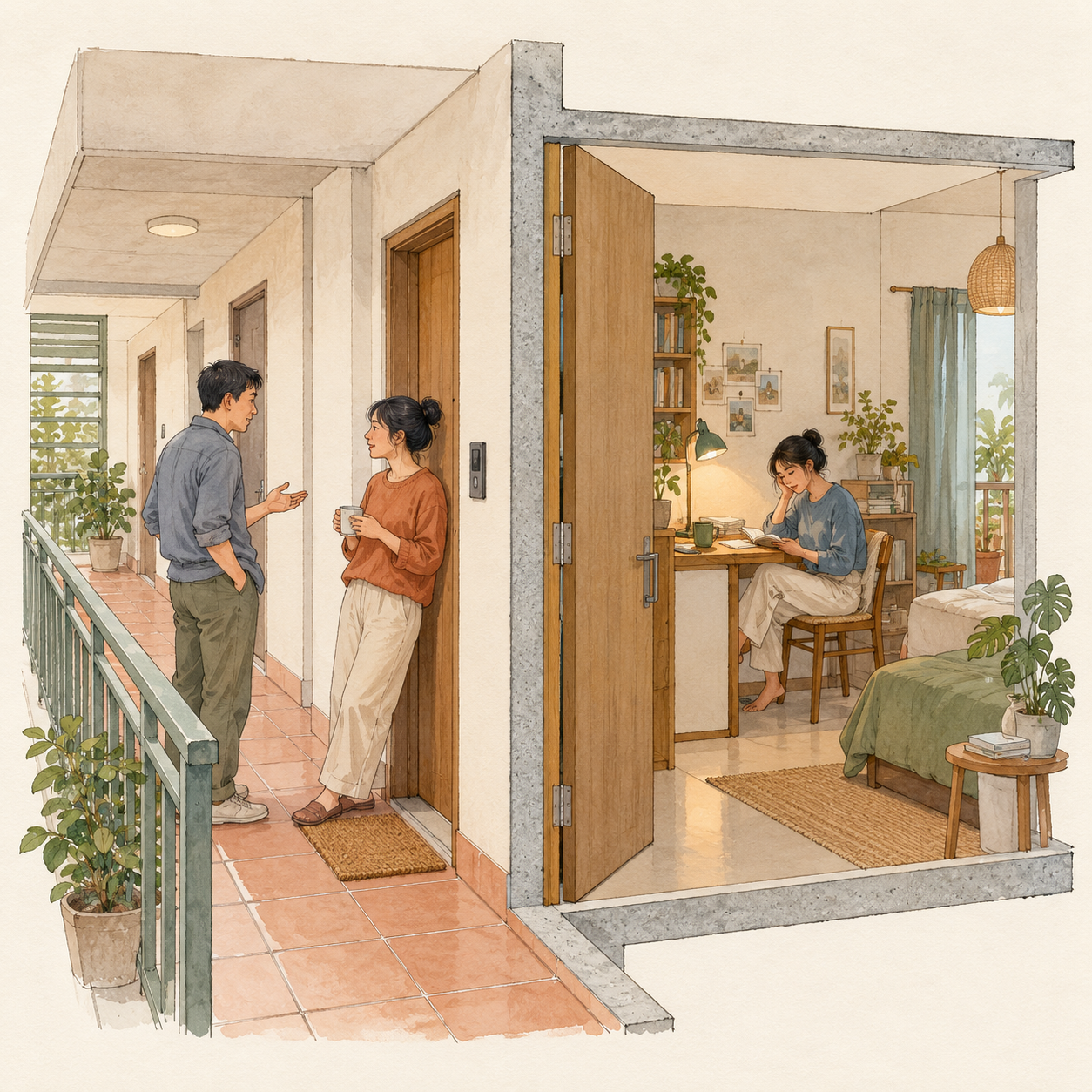
But turn the scene around. Perhaps you are exhausted. Perhaps the conversation is taking place directly outside your bedroom. What feels like community to one resident can feel like an intrusion to another.
Can a building make meeting easy without making participation unavoidable?
Research from Hanoi gives this question a concrete setting. In four high-rise neighbourhoods providing social and low-cost housing, researchers collected questionnaires and one-day interaction diaries from 274 residents, alongside 45 interviews. The study was published on 27 June 2020, following fieldwork in July–September 2019.
Circulation areas, including corridors, lift lobbies and entrances, accounted for 46% of recorded social interactions. Common rooms were available, yet reportedly rarely used because they were small, inconvenient or poorly equipped. Residents also described noise, privacy and safety concerns when circulation spaces accommodated other activities. These were recorded interactions and reported experiences, not proof that a particular layout produces friendship. Original research
For apartment design, this raises a question beyond whether a shared room appears on the accommodation schedule.
Where does it sit in relation to the ordinary walk home? Can someone notice an activity before deciding to enter? Can two people continue a conversation without occupying the route everyone else must use?
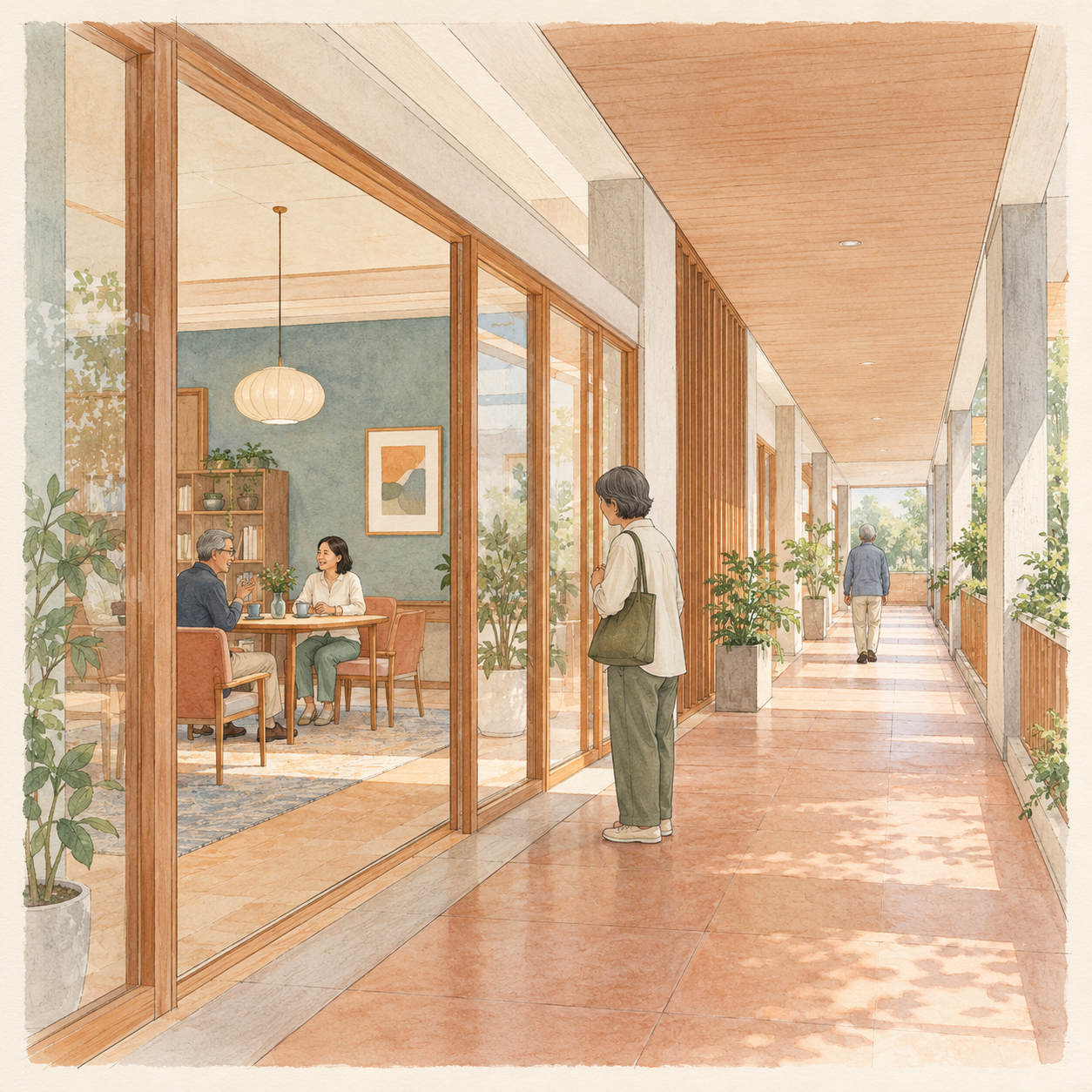
Consider a shared space beside a daily route, with a clear entrance and somewhere to pause outside it. A resident could acknowledge a neighbour, stop for a moment or continue home. This is a design proposition to test, not a proven remedy from the Hanoi research.
The distinction matters at the front door, too. Placing every household directly against a gathering area might increase exposure while removing the distance that makes an encounter comfortable. A change of orientation, a small transition or acoustic separation could offer privacy without turning the building into a sequence of sealed compartments.
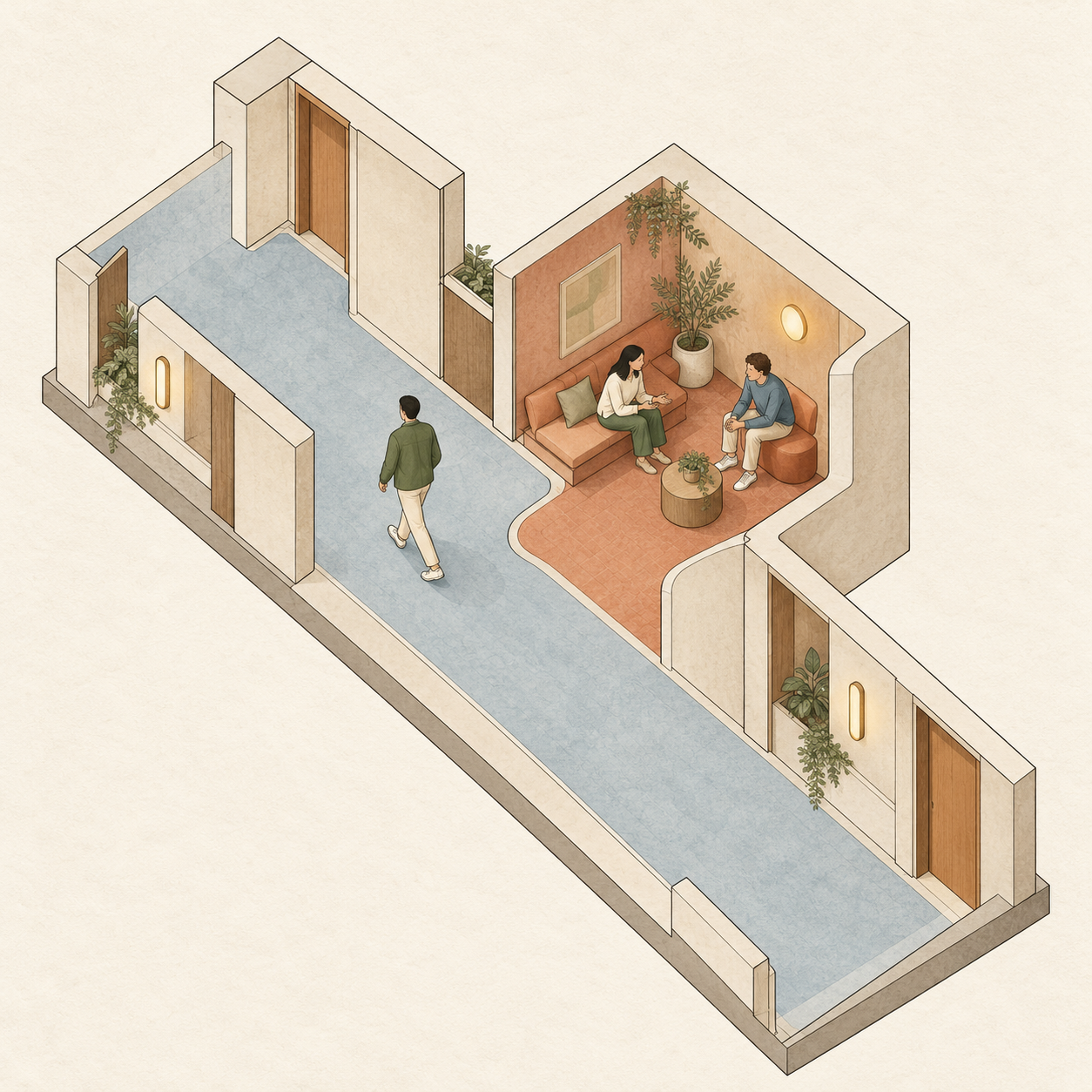
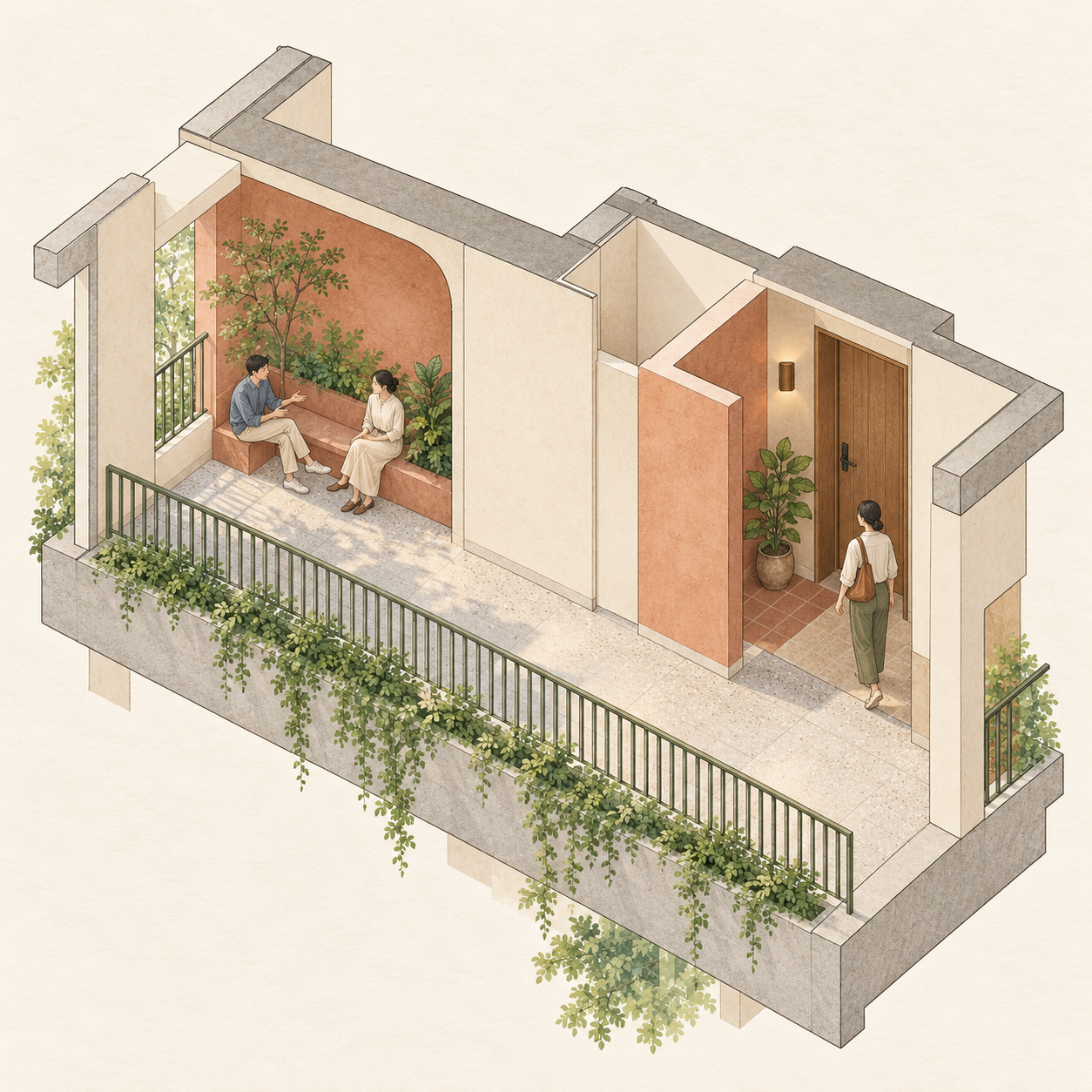
Any arrangement would still need to protect accessible circulation and escape routes. Furniture placed in a passage is not automatically an improvement simply because people use it.
For TheeAe’s Design Beyond Form movement, the walk from the lift to the front door deserves attention as part of the experience of home. Its value cannot be judged only by how efficiently it distributes apartments, or how many encounters it generates.
The more useful ambition is choice: enough familiarity to recognise someone, enough room to exchange a few words, and enough consideration to leave each other in peace.
Back at the lift, the conversation may last ten seconds or ten minutes. Architecture cannot decide which it should be. It can give both possibilities somewhere to happen.
Research revisited: this article draws on a study published in 2020, following fieldwork in 2019. It is not current news. The opening scene is hypothetical, and the architectural applications are design propositions.
Related Picks
As an Amazon Associate I earn from qualifying purchases.

Design Beyond Form by Chris Woohyun Cho — View on Amazon (paid link)
A closer look at architecture shaped by people, place and everyday life—through the questions and experiences behind the design.
Further Reading
National Design Guide: Homes, Shared Spaces and Privacy
Free official resource · non-affiliate
The guide considers comfort, privacy and the relationship between private, shared and public space. Its Homes and Buildings and Lifespan sections offer a useful checklist for examining the everyday route home. This is English planning guidance, not a substitute for local project requirements.
Related Articles
The Shops Are Close. Why Does the Walk Still Feel Difficult?